


Recoleta Cemetery
Once the first public cemetery in the city, it is today an open-air museum that houses the great makers of the country’s history. Between legends and stories that were captured in the imagination and majestic works of funerary architecture, we invite you to tour this National Historical Heritage.
Story
This famous burial park, neighbouring The Basilica Nuestra Señora del Pilar, was founded in the beautiful Recoleta District, which owes its name to the convent of the Recollect monks located there. The cemetery was built in what was once the old monks’ garden.
The Recoleta Cemetery was built in 1822 after the government decided to expropriate the lands from the Recollect monks. It became the first public burial ground in Buenos Aires. Its original name was Northern Cemetery, and the layout is the work of the French engineer Próspero Catelin.
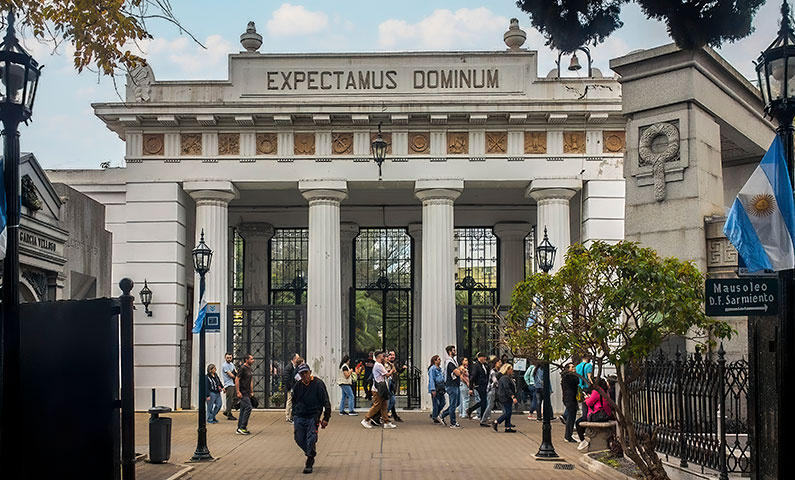
The main entrance to the Recoleta Cemetery. Photo © @alieniger
Towards the end of the 19th century, when the city’s wealthiest families began to move to this area, this cemetery became their chosen resting place. Among the many personalities buried in the Recoleta Cemetery are political leaders, presidents of the Nation, writers, Nobel Prize winners, athletes, and businessmen.
The Recoleta Cemetery occupies five hectares. Many great Argentinian personalities rest in its imposing vaults and mausoleums.
The buildings that make up the Recoleta heritage complex show beautiful marble decorations and sculptures, artworks of prominent architects and artists. More than 90 burial chambers have even been declared National Historic Monuments. Inside the Cemetery, we can find more than 45,000 funeral monuments of very different styles, including Greek temples and even Egyptian pyramids.
The Recoleta Cemetery is a popular destination for tourists and locals alike, not only for its numerous and imposing mausoleums and vaults but also for its architectural value, since this is an authentic sample of the emerging economic times when the main families of the city competed to build the best splendid graves.
However, this iconic place deserves to be visited and toured for the multiple stories and curiosities hidden in its mausoleums, in addition to being the place where prominent aristocratic personalities and figures rest.
Some of the most visited graveyards are those of Eva Perón (Evita), Luis Federico Leloir and Adolfo Bioy Casares.
Curiosities
The vaults and tombs belong, for the most part, to the aristocratic families of Argentina. They own private areas and pay an annual administration fee. The Recoleta Cemetery has a curious record since it is the favourite area to live in the city.
There are many fascinating stories along the Recoleta Cemetery paths, in addition to being a beautiful display of art and history. For instance, the parents of Liliana Crociati, who died during her honeymoon, built a vault reproducing her bedroom.
At the entrance, they placed a sculpture of her, wearing her wedding dress (in which she was buried) and accompanied by her inseparable dog. This statue is located in a small garden, so it always has flowers, according to her family, Liliana preferred to see them in her plants and not in bouquets.
You can also see the last resting place of David Alleno, who had been the caretaker of the cemetery and who saved money during his entire life to be able to build his tomb there.
In the Cemetery there is the statue of Christ the Redeemer, although in the cemetery it is known as the central Christ, since it is located in the centre It was made in 1914 and is a very particular statue: It’s the figure of an old man, because it is a representation of Christ in what could have been his old age.
However, this is not the only distinct thing about the statue, a few years ago, for no apparent reason, water began to flow from Christ’s hands. This event, in addition to being compelling, was at first considered a miracle. Some time later it was linked to the previous use that had been given to that land ( the Recollect monks’ garden).
The most notable sepulchre within the Recoleta Cemetery is the one that belongs to Eva Perón. To protect her body, Evita’s family decided that the coffin would be located underground, five metres deep. In addition, the entrance to the venue is armoured, as is the coffin. For this reason, visitors will only find large statues or ornaments. The place is quite simple since it is where the entire Evita family, the Duarte, is located. However, the place is easy to recognize, since it always has flowers that some people leave to honour her memory.
Visit to the Cemetery
Home to notable vaults and mausoleums, the Recoleta Cemetery is considered an open-air museum. It has an important collection of works of art made of marble, bronze and also stained glass. Renowned architects, sculptors and different artists left their mark on the place.
Some of the sculptors and artists behind the fabulous place are Luis Perlotti, Jose Fioravanti, Carlos Romairone, Rene Sargent, Alfredo Bigatti, Jean Alexandre Falguière, Miguel Sansebastiano, Antonin Mercie, Luis Carriere, Pedro Zonza Briano, Alfredo Guttero and Tasso.
In addition, the burial park is the resting place of personalities like Hipolito Yrigoyen, Domingo Faustino Sarmiento, Jose Marble, Almte William Brown, Facundo Surgery, Manuel Dorrego, John Lavalle, Leonard N.In addition, Arturo Illia, José C. Paz, Raúl Alfonsín, Federico Leloir, Luis Ángel Firpo, and Victoria Ocampo, among others.
As it has so much history inside, we recommend that you seek information before visiting the Cemetery or join the guided tours, which will give you an explanation along the tour of the most important tombs.
It is also important to remember that the Recoleta Cemetery is not marked inside, so it is advisable to download a map if you want to visit and avoid getting lost, since it is rather large.
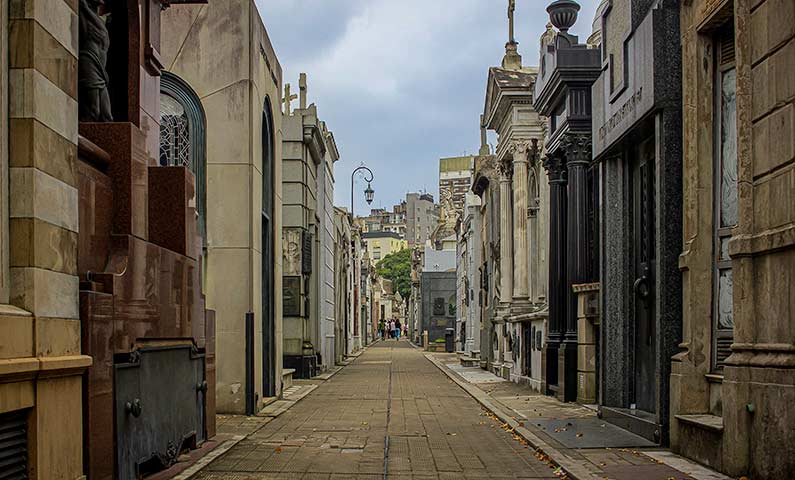
View of a street inside the cemetery. Photo © @alieniger
Cemetery Surroundings
Mayor Alvear Square
Better known as Plaza Francia, it is located in the heart of Recoleta and is visited by thousands of Buenos Aires residents in their free time to enjoy the park and visit its fair on weekends. Recollect monks settled the square in the 18th century, giving the name to the neighbourhood. Later, they added the Pilar church, the Recoleta Cultural Centre.
Pilar Church
It is the second-oldest building in Buenos Aires and the most intact and beautiful colonial sanctuary in the city. It was originally a convent until the friars were expelled in 1822. The church is simple and beautiful, with altarpieces that transport you to the Buenos Aires colonial village. You can visit it without any restrictions and even attend Catholic mass.
Recoleta Cultural Centre
Located next to the Pilar Church, the Recoleta Cultural Centre is a strange combination of buildings of the old Franciscan convent and an old asylum. From the asylum, only a Bordeaux-coloured neo-Romanesque chapel remains, which can be seen from the square ravine. There you’ll find a pleasing food court. The cultural centre usually hosts temporary exhibitions and shows of street art, electronic music, hip hop and other cultural expressions.
National Museum of Fine Arts
The most important art museum in Argentina is located in Recoleta. It has an impressive collection of classical art from all periods and modern art. We recommend seeing the works of Argentine Art from the 19th and 20th centuries that portray life and traditions, and the different movements that have influenced the visual arts of our country.
Faculty of Law and Generic Floralis
One of the classic places to enjoy when the sun goes down is the Faculty of Law, located on Figueroa Alcorta Avenue near Plaza Alvear.
Next to the faculty is the stunning Floralis Genérica, a great modern icon of Buenos Aires that represents the universal Flower. Made of steel by the Argentine architect Eduardo Catalano, the artist donated it to the city.
The Grand Splendid Athenaeum
A little closer to the town centre and away from the rest of the attractions on this list is El Ateneo Grand Splendid, the most beautiful bookstore in Buenos Aires. It used to be an old theatre called Grand Splendid, inaugurated at the beginning of the 20th century and through which some of the greatest artists of Argentine Tango passed. In 2000, it was transformed into an immense bookstore, part of the large El Ateneo chain. Its boxes, ornaments, curtains and the beautiful fresco of the dome have been maintained.
La Biela
This beautiful, notable bar is opposite the Recoleta Cemetery and has a lot of history. Great people from Argentina have sat at its tables, and it is also part of one of the legends that the Cemetery contains.
One of the urban myths about the district says that one night, a man met a beautiful lady dressed in white in the cafeteria, who said her name was Luz María. After lending her his jacket, the man fell madly in love, but the woman ran off in the direction of the Cemetery, stating that it was too late. He managed to enter the Cemetery to find the grave of Luz María Velloso, who had died in 1925.
Opening Hours
Public attention: Monday to Sunday from 8 a.m. to 2 p.m. Cremation service is not performed.
Visits: Monday to Sunday from 7 a.m. to 6 p.m.
Tourist visits: Monday to Sunday from 9 am to 5 pm
An Unforgettable Experience
A visit to the Recoleta Cemetery is a must, both for its architectural beauty in its mausoleums and statues, along for the vast history contained in its walls. No doubt, it is not so common to tour among tombs and graves but one thing’s for sure, you are going to have a once-in-a-lifetime experience.
Junín 1760, Recoleta.
Find the Recoleta Cemetery on the map.