


National Museum of Fine Arts
GUIDE TO ONE OF THE MOST FAMOUS MUSEUMS IN BUENOS AIRESThe National Museum of Fine Arts features the largest collection of Argentine art and one of the principal collections of universal artwork in Latin America. Its heritage includes international and Argentine works from the Middle Ages to the 20th century, by artists such as Picasso, Goya, Van Gogh and Rodin.
Located in the Recoleta neighbourhood, near the Cemetery and the Floralis Genérica, you’ll find the National Museum of Fine Arts. In addition to being immense, the collection of works it houses brings together the most renowned artists worldwide.
Not only is it one of the most important museums in Latin America, but it also has the largest collection of national art in the country. Paintings, drawings, engravings, sculptures and various objects from the Middle Ages to the 20th century are exhibited in its rooms.
The magnificent National Museum of Fine Arts is made up of more than 12,000 works, an artistic library with more than 150,000 volumes and features an auditorium of 320 square metres.
With more than 120 years of history, the National Museum of Fine Arts collection includes artistic treasures from different periods. Its original director, Eduardo Schiaffino, artist, critic and first Argentine art historian, planned a metropolitan museum that would allow the public to walk through the history of art, following the example of contemporary European and North American galleries.
Throughout 34 of the colourful rooms, the MNBA exhibits a total of 700 elements, evidencing its huge cultural value.
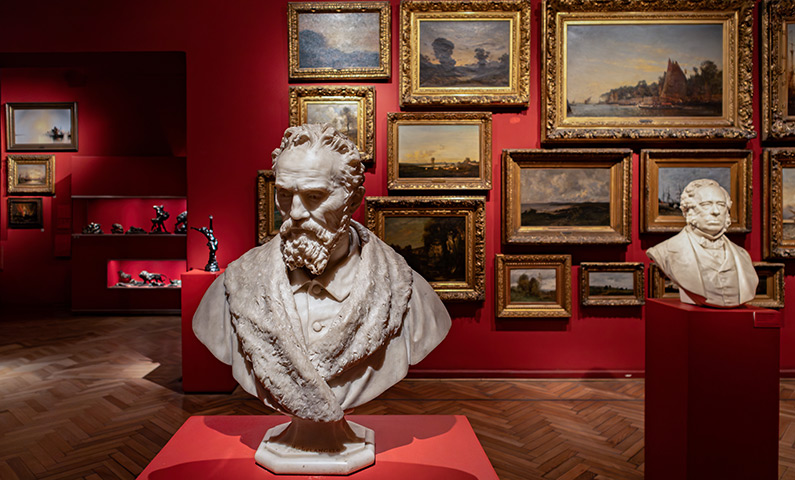
National Museum of Fine Arts in Buenos Aires. Photo © shutterstock.com
We invite you to discover one of the most impressive museums in Buenos Aires. Be amazed by its permanent collections and temporary exhibitions.
History
The National Museum of Fine Arts was inaugurated on December 25, 1896, at the Bon Marché store building on Florida Street, where Galerías Pacífico is currently located.
The idea of generating a space intended to house international art from all historical periods, along with the promotion of Argentine works, has marked the museum from its beginnings.
By the time of the Centennial of the May Revolution, the MNBA already had many invaluable pieces by Francisco de Goya, Joaquín Sorolla y Bastida, Edgar Degas and Pierre-Auguste Renoir in its collection. Its second venue, inaugurated in 1922, was the Argentine Pavilion. This space was an iron and glass palace used for the Paris Universal Exhibition in 1889. New acquisitions that expanded the collection were exhibited there: The Surprised Nymph (Édouard Manet), and Banks of the Seine (Claude Monet).
In 1933, the MNBA was moved to its current building. Formerly the Recoleta Pump House, it was remodelled by architect Alejandro Bustillo to house the museum. Outstanding pieces were added to the collection, such as Sea Woman (Paul Gauguin), The Moulin de la Galette, (Vincent van Gogh) and Jesus in the Garden of Olives (El Greco).
The museum’s wide-ranging collection grew considerably during the last decades of the 20th century, adding works by great leaders of international modern art: Pablo Picasso, Amedeo Modigliani, Marc Chagall, Vassily Kandinsky, Paul Klee, Lucio Fontana, Jackson Pollock, Mark Rothko and Henry Moore.
The rooms of the MNBA also host a vast production of Argentine art. Works by Candido Lopez, Prilidiano Pueyrredon, Emilio Pettoruti, Xul Solar, Raquel Forner, Grete Stern, Antonio Berni, Alicia Penalba, Gyula Kosice, Marta Minujin, Antonio Segui and Leon Ferrari are part of the collection.
The space possesses an extensive inventory of Latin American artworks by Pedro Figari, Joaquín Torres García, Tarsila Do Amaral, Diego Rivera and Jesús Rafael Soto, among others.
Over its more than 120 years of history, the National Museum of Fine Arts national and international art pieces have positioned it as one of the most relevant cultural institutions in America.
How the Exhibitions are Distributed
The National Museum of Fine Arts building is spread over 3 floors and has 34 exhibition rooms, 24 of them located on the ground floor, 8 on the first floor and 2 on the second.
On the lower floor, you can see permanent displays of European art from the 12th to 19th centuries and Argentine pieces from the 19th century. Works of pre-Hispanic, Colonial and Argentine art starting from the 19th century, along with rooms dedicated to Goya and Rodin, are also part of the selection.
Here, you will find a room that exhibits the Panels of the Conquest of Mexico, an emblematic example of mixed culture colonial art. Also exhibited on this floor is the collection donated by film director María Luisa Bemberg, which incorporates the avant-garde art tendencies from Rio de la Plata.
The SUM, the Exhibition Pavilion and the museum store also stand here. The Raquel Calles de Edelman Library, a public library specialising in art that has a heritage of 150,000 volumes, occupies part of the ground floor at the moment. The MNBA auditorium is located on the first floor where different artistic activities take place.
On the first floor, you can also find rooms dedicated to international and Argentine art of the 20th century.
The museum’s wide compilation of international art includes the most important works of European art in South America, commencing from the Middle Ages to the 20th century. Paintings by Tintoretto, El Greco, Rembrandt, Zurbarán, Tiepolo and medieval masters are exhibited along with María Luisa Bemberg’s former collection.
The permanent exhibition includes artworks by several avant-garde masters of the early 20th century such as Klee, Kandinsky, De Chirico, Carrà, Modigliani, Picasso and Léger. Postwar trends are represented by European artists: Nicholson, Fontana, Vasarely, Dubuffet, Fautrier, Saura, Alechinsky and Henry Moore, while the American section includes paintings by Rothko, Pollock and Nevelson.
On the second floor, you will find another temporary exhibition room and the sculpture terraces.
Important Information
The National Museum of Fine Arts provides disabled access and offers guided tours. Visits for visually impaired people are held on Saturdays. Contact number for reservations: (011) 5288-9900.
Although admission is free, this is only for Argentine citizens. Foreigners must pay the entrance fee.
Taking photos inside the museum is allowed without a flash or tripod to avoid damaging the exhibitions. It is not permitted to access food or drinks.
Times: Tuesday to Friday from 12:30 p.m. to 8:30 p.m., and Saturdays and Sundays from 9:30 a.m. to 8:30 p.m.
Where Art and Culture Meet
This is one of the main museums in the city, and part of its interest lies in the variety of its collections. The extensive inventory and the location close to many attractions in the city, make the MNBA a must-see for anyone visiting Buenos Aires. Are you ready for a tour? We hope you enjoy it.
Libertador Avenue 1473, Recoleta
Find the National Museum of Fine Arts of Buenos Aires on the map
You might also enjoy these guide

Recoleta Cemetery
Once the first public cemetery in the city, it is today an open-air museum that houses the great makers of the country's history. Between legends and stories that were captured in the imagination and majestic works of funerary architecture, we invite you to tour this...